by Gary Powell
For the students from the University of Texas Butler School of Music (MUS 339M)
Professor Glenn Richter asked me to pose a question or two for your contemplation. Below you will find several from which to choose. I will look forward to plunging the depths with you next Wednesday, October 20, 2010.
 “Notes are the tiny fragments of sound that, when artfully strung together, become emotions, landscapes, storms, and dreams. Composers and the musicians who perform their works must be very aware of the notes, as they are the means through which the former translate their meaning into something the latter can understand. However, without the meaning the notes have no purpose, and the musicians must artfully translate the written music into expressive sounds.”
~ Laura Rando, Notes Become Three
Laura Rando’s description of the importance of music composition brings up an important question; with whom are you going to do business? Regardless of your chosen discipline within the music industry, you will have to make this decision. Best it be conscious!
Let’s assume you agree with Laura Rando. If so, who is the keeper of the flame and where is the temple of righteousness? You have a few choices for clients, most of which are large organizations or corporations. To narrow the list there are record companies, television networks, movie studios and universities. I’ve purposefully omitted one holder of the truth for you to discover yourself or maybe you have others to suggest as well.
It’s best to choose your lane before being forced into making a wrong turn!
Most students have limited access to advice from professionals who have worked within these companies or institutions. Most professors have gads of feedback for living a professional life in academia, but limited experience in working within corporate entertainment production companies. That said, some composers have worked for decades within these production companies and still can’t explain in any cogent manner what happened. Now you, the gifted, the talented, our hope for the future – have some work to do!
As a serious student musician or student of the music business, you will certainly hope to find work with people who share your intrinsic and artistic values. To fully understand yourself, it might be important to grapple with some of these artistic existential questions: What is art? What is it’s highest and best use? Why does entertainment sometimes quit entertaining? When does entertainment transform into high art. How does the idea of high art drop into meaninglessness? What are the effects of money on the production of all art and entertainment? Where does the money come from and where does it go? Just how transparent is the funding of any production or position?
You can bet I have answers for all these questions, but they’ve been rendered unfortunately in hindsight. Here’s the gift; you can learn from my experience without it having to be your experience. Your forthcoming decision should include defining what you value and then identifying the organizations or people which share that value. This is hopefully where you will spend you life. However, without a gold-template reference of what’s really out there, this exercise becomes rather academic. So, it’s time to continue your initial reality research through this class and then maybe do some further research on yourself as well. Seldom will these two research papers match, but doesn’t have to be that way! See you next Wednesday. I’ll be the tall white-headed one.
All Content of Gary Powell’s Site is Licensed Under a
Creative Commons Attribution-NonCommercial-NoDerivs 2.5 License

.
by Gary Powell
For the students from the University of Texas Butler School of Music (MUS 339M)
Professor Glenn Richter asked me to pose a question or two for your contemplation. Below you will find several from which to choose. I will look forward to plunging the depths with you next Wednesday, October 20, 2010.
“Notes are the tiny fragments of sound that, when artfully strung together, become emotions, landscapes, storms, and dreams. Composers and the musicians who perform their works must be very aware of the notes, as they are the means through which the former translate their meaning into something the latter can understand. However, without the meaning the notes have no purpose, and the musicians must artfully translate the written music into expressive sounds.”
~ Laura Rando, Notes Become Three
Laura Rando’s description of the importance of music composition brings up an important question; with whom are you going to do business? Regardless of your chosen discipline within the music industry, you will have to make this decision. Best it be conscious!
Let’s assume you agree with Laura Rando. If so, who is the keeper of the flame and where is the temple of righteousness? You have a few choices for clients, most of which are large organizations or corporations. To narrow the list there are record companies, television networks, movie studios and universities. I’ve purposefully omitted one holder of the truth for you to discover yourself or maybe you have others to suggest as well.
It’s best to choose your lane before being forced into making a wrong turn!
Most students have limited access to advice from professionals who have worked within these companies or institutions. Most professors have gads of feedback for living a professional life in academia, but limited experience in working within corporate entertainment production companies. That said, some composers have worked for decades within these production companies and still can’t explain in any cogent manner what happened. Now you, the gifted, the talented, our hope for the future – have some work to do!
As a serious student musician or student of the music business, you will certainly hope to find work with people who share your intrinsic and artistic values. To fully understand yourself, it might be important to grapple with some of these artistic existential questions: What is art? What is it’s highest and best use? Why does entertainment sometimes quit entertaining? When does entertainment transform into high art. How does the idea of high art drop into meaninglessness? What are the effects of money on the production of all art and entertainment? Where does the money come from and where does it go? Just how transparent is the funding of any production or position?
You can bet I have answers for all these questions, but they’ve been rendered unfortunately in hindsight. Here’s the gift; you can learn from my experience without it having to be your experience. Your forthcoming decision should include defining what you value and then identifying the organizations or people which share that value. This is hopefully where you will spend you life. However, without a gold-template reference of what’s really out there, this exercise becomes rather academic. So, it’s time to continue your initial reality research through this class and then maybe do some further research on yourself as well. Seldom will these two research papers match, but doesn’t have to be that way! See you next Wednesday. I’ll be the tall white-headed one.
All Content of Gary Powell’s Site is Licensed Under a
Creative Commons Attribution-NonCommercial-NoDerivs 2.5 License
.
by Gary Powell
Before we go forth into the world wielding our grand visions, there is some personal housekeeping to be done. Otherwise, our grandest vision will drip onto the world as tepid back-flow from someone else’s previously held ideas. But, you say “I know what I want and how I want to change the world.” Well, for a moment let’s look at you and try to understand how many institutions you have been associated and with some living below your awareness. Answer the questions below, then add up how many “yes” answers you accumulate. Read below to assess your score. 
1. Were you born a human? (if so add ten yes marks)
2. Were you born a boy?
3. Were you born a girl?
4. Were you raised by both parents?
5. Were you raised by your father only? (if so add two yes marks)
6. Were you raised by your mother only? (if so add two yes marks)
7. Were you raised by your grandparents?
7. Were you raised by a grandfather? (if so add two yes marks)
8. Were you raised by a grandmother? (if so add two yes marks)
9. Were you raised within a state or any other system for child services? (if so add four yes marks)
10. Were you raised by wolves?
11. Did you go to kindergarten?
12. Did you go to pre-school?
13. Did you go to elementary school?
14. Did you go to middle school?
15. Did you go to high school?
16. Did you date in high school?
17. Did you not date in high school?
18. Are you in college? (Add one yes mark for every year spent in undergraduate college)
(Add two yes marks for every year spent in graduate school)
19. Have you ever suffered unfair consequences for your behavior?
20. Have you ever felt betrayed?
21. Have you even betrayed a friend or family member?
22. Have you ever joined a civic, scholastic, religious or professional organization? (Add three yes marks for each one per year)
23. Did you ever believe in Santa Claus? (Add 10 yes marks if true.)
24. Can you name members of any current or past rock and roll bands? (Add one yes mark per name.)
25. Can you explain your wardrobe or “look” using reason?
26. Are you wearing fall or winter boots when it’s still 87 degrees outside? (Add 5 yes marks if true.)
27. Have you ever used an excuse to avoid a party or commitment you didn’t want to attend?
If you have more than 50 points, then you are nearly unconscious with no self-awareness. If you have 12 points or fewer then you were probably raised by wolves and will soon either be in prison or running for congress. Is this a stupid list of questions posing as a sociological study? Of course it is. Did you get the point? If not, the point is this; as individuals we must unveil the hidden agenda of others living within our proximity, circumstance and psychology. We have to become free.
In a discussion of people’s goals, Rae Moses, composer and Head of Choral Music for Carl Fischer Music writes, “Obscurity and poverty never seem to make the list of desired outcomes.” Right, they don’t. So, it’s clear that no one desires to be broke and “just a nobody.” And so two more questions; why do so few achieve the opposite and second, why is obscurity and poverty a rare outcome for most educated people? The answer; most of us are willing to live with obscurity, much more than poverty, so we simply redirect our energies to producing income rather than reaching for our aspirations, however exalted. Second, achieving both fame and riches first requires the ambitious to trespass into someone’s territory, without getting kicked out, to eventually gain invitation for entering a curriculum which has never been taught in school. There is no known path to this new school or we would all be doing it.
Assuming you have broken through the massive life-compressing limitations of how you have been personally compromised and then achieved some manner of self-awareness; here is the question. Given enough time and money and with no worries of supporting oneself, what would you do with your life? And, what would your world look like to others and how would they recognize it? Further, how would others prosper within it?
For further reading: Erikson’s Stages of Psychosocial Development
All Content of Gary Powell’s Site is Licensed Under a
Creative Commons Attribution-NonCommercial-NoDerivs 2.5 License
.
by Gary Powell
Before we go forth into the world wielding our grand visions, there is some personal housekeeping to be done. Otherwise, our grandest vision will drip onto the world as tepid back-flow from someone else’s previously held ideas. But, you say “I know what I want and how I want to change the world.” Well, for a moment let’s look at you and try to understand how many institutions you have been associated and with some living below your awareness. Answer the questions below, then add up how many “yes” answers you accumulate. Read below to assess your score.
1. Were you born a human? (if so add ten yes marks)
2. Were you born a boy?
3. Were you born a girl?
4. Were you raised by both parents?
5. Were you raised by your father only? (if so add two yes marks)
6. Were you raised by your mother only? (if so add two yes marks)
7. Were you raised by your grandparents?
7. Were you raised by a grandfather? (if so add two yes marks)
8. Were you raised by a grandmother? (if so add two yes marks)
9. Were you raised within a state or any other system for child services? (if so add four yes marks)
10. Were you raised by wolves?
11. Did you go to kindergarten?
12. Did you go to pre-school?
13. Did you go to elementary school?
14. Did you go to middle school?
15. Did you go to high school?
16. Did you date in high school?
17. Did you not date in high school?
18. Are you in college? (Add one yes mark for every year spent in undergraduate college)
(Add two yes marks for every year spent in graduate school)
19. Have you ever suffered unfair consequences for your behavior?
20. Have you ever felt betrayed?
21. Have you even betrayed a friend or family member?
22. Have you ever joined a civic, scholastic, religious or professional organization? (Add three yes marks for each one per year)
23. Did you ever believe in Santa Claus? (Add 10 yes marks if true.)
24. Can you name members of any current or past rock and roll bands? (Add one yes mark per name.)
25. Can you explain your wardrobe or “look” using reason?
26. Are you wearing fall or winter boots when it’s still 87 degrees outside? (Add 5 yes marks if true.)
27. Have you ever used an excuse to avoid a party or commitment you didn’t want to attend?
If you have more than 50 points, then you are nearly unconscious with no self-awareness. If you have 12 points or fewer then you were probably raised by wolves and will soon either be in prison or running for congress. Is this a stupid list of questions posing as a sociological study? Of course it is. Did you get the point? If not, the point is this; as individuals we must unveil the hidden agenda of others living within our proximity, circumstance and psychology. We have to become free.
In a discussion of people’s goals, Rae Moses, composer and Head of Choral Music for Carl Fischer Music writes, “Obscurity and poverty never seem to make the list of desired outcomes.” Right, they don’t. So, it’s clear that no one desires to be broke and “just a nobody.” And so two more questions; why do so few achieve the opposite and second, why is obscurity and poverty a rare outcome for most educated people? The answer; most of us are willing to live with obscurity, much more than poverty, so we simply redirect our energies to producing income rather than reaching for our aspirations, however exalted. Second, achieving both fame and riches first requires the ambitious to trespass into someone’s territory, without getting kicked out, to eventually gain invitation for entering a curriculum which has never been taught in school. There is no known path to this new school or we would all be doing it.
Assuming you have broken through the massive life-compressing limitations of how you have been personally compromised and then achieved some manner of self-awareness; here is the question. Given enough time and money and with no worries of supporting oneself, what would you do with your life? And, what would your world look like to others and how would they recognize it? Further, how would others prosper within it?
For further reading: Erikson’s Stages of Psychosocial Development
All Content of Gary Powell’s Site is Licensed Under a
Creative Commons Attribution-NonCommercial-NoDerivs 2.5 License
.
What if we lived in a world of “no wrong notes?” Before finding our own creative identity, we can either feel completely free or maybe even horribly oppressed. Either mindset can be a great motivator for substantive contribution to self and then to a larger audience and ultimately community. Beyond developing talent, this is what I aim to release in singers.
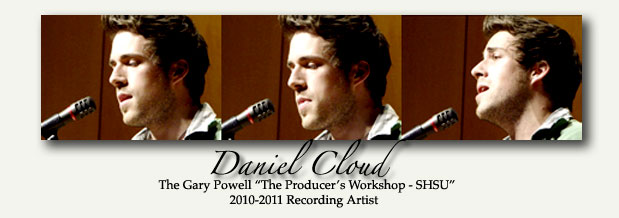
Enter thirteen singers, all students at Sam Houston State University in Huntsville, Texas. Without much knowledge of what they were getting themselves into, each auditioned and won a spot to participate in “The Producer’s Workshop.” This workshop is designed to identify talent and train singers to perform within the skill-set required to be a professional recording studio-session singer. Within that discipline almost every style of singing is demanded. This workshop is not for the shy or timid. This takes great courage, as most of the singing is improvised and the ear gets as much a work-out as the voice. Here’s the deal: after twelve hours of training, I choose one singer to travel to my Austin recording studio to record one song written and produced to compliment the singer. This year that recipient is Daniel Cloud, an accounting major, who when asked during our show where he was from quipped, “my mother’s womb?” Daniel was also given a $300 cash prize from the “Friends of Music” at Sam Houston State University.
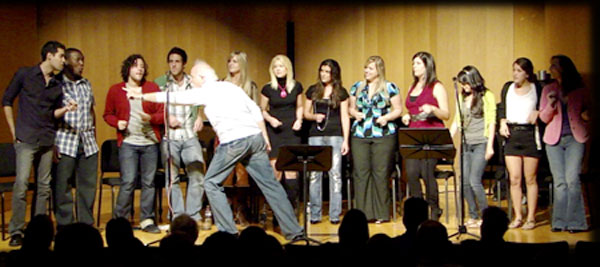 Pictured Above from Left to Right:
Stewart Gaiton, Cliff Randle, Ben Montes, Daniel Cloud, Gary Powell, Julia Green, Brandi Barger, Brooke Swanson,
Hannah Miscisin, Kiersten Ortiz, Vicki Villarreal, Tara Shackelford, Jenny Thayer. (Linky Dickson, not pictured)
The brave singers, all students at Sam Houston State University, came from different schools across the campus, although most were from the Musical Theatre Department and School of Music. Thank you to
Dr. James M. Bankhead, Director of the
School of Music and host for this workshop. Daniel Cloud’s upcoming recording will be available in early Spring, 2011.
What if we lived in a world of “no wrong notes?” Before finding our own creative identity, we can either feel completely free or maybe even horribly oppressed. Either mindset can be a great motivator for substantive contribution to self and then to a larger audience and ultimately community. Beyond developing talent, this is what I aim to release in singers.
Enter thirteen singers, all students at Sam Houston State University in Huntsville, Texas. Without much knowledge of what they were getting themselves into, each auditioned and won a spot to participate in “The Producer’s Workshop.” This workshop is designed to identify talent and train singers to perform within the skill-set required to be a professional recording studio-session singer. Within that discipline almost every style of singing is demanded. This workshop is not for the shy or timid. This takes great courage, as most of the singing is improvised and the ear gets as much a work-out as the voice. Here’s the deal: after twelve hours of training, I choose one singer to travel to my Austin recording studio to record one song written and produced to compliment the singer. This year that recipient is Daniel Cloud, an accounting major, who when asked during our show where he was from quipped, “my mother’s womb?” Daniel was also given a $300 cash prize from the “Friends of Music” at Sam Houston State University.
Pictured Above from Left to Right:
Stewart Gaiton, Cliff Randle, Ben Montes, Daniel Cloud, Gary Powell, Julia Green, Brandi Barger, Brooke Swanson,
Hannah Miscisin, Kiersten Ortiz, Vicki Villarreal, Tara Shackelford, Jenny Thayer. (Linky Dickson, not pictured)
The brave singers, all students at Sam Houston State University, came from different schools across the campus, although most were from the Musical Theatre Department and School of Music. Thank you to
Dr. James M. Bankhead, Director of the
School of Music and host for this workshop. Daniel Cloud’s upcoming recording will be available in early Spring, 2011.