<p>by Gary Powell</p>
<p>Emma Kate Tsai, an often contributor to my site, has posed this excellent question regarding the perceived color of tonal centers:<br />
<center><i>I have to write a research paper on music and how it collaborates with another art.  I&#8217;m reading this new novel about a guy who can hear the tonality of people.  I talked to my prof about it and she said that a lot of composers think people have &#8220;tonality&#8221;, in other words, certain keys are uplifting, others are somber.  What do you think?</i> &#8211; Emma Kate Tsai</center><br />
<center><img decoding="async" loading="lazy" src="http://www.garypowell.com/blogs/wp-content/wp-photos//color_of_key.jpg" width="384" height="200" alt="color of key"/></center><br />
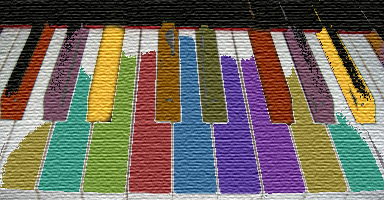
Yes Emma, composers have always talked about the idea that the key of <em>E Minor</em> does not &#8220;feel&#8221; the same as <em>Eb Minor</em> even though they are only a half-step apart.  There is often agreement that tonal centers on black keys have a darker tone than tonal centers on white keys.  It&#8217;s possible that this perceived <i>audio</i> difference is more <i>visual</i>, and even tactile as well, in that the pianists&#8217; fingering shifts deeper into the keyboard when playing black keys.  As an antidote to this, I encourage myself to compose in all keys to eliminate compositional patterns that one develops when playing only in <em>Bb Major</em>, for instance.  If a songwriter or composer does notice that she prefers certain tonal centers or <i>keys</i>, like I mentioned, it may be more about muscle memory, which comes from familiarity with chord voicing in certain <i>keys</i>, than about any measurable or even perceived auditory color differences.  I do hold, however unreliable the science is, that we can and do perceive a difference in the tonal nature of the keys we choose to play in.</p>
<p>Studies show that people with perfect pitch hear the <em>character</em> of a pitch instead of what we generally assume; that they are simply hearing the frequency. This is one argument to support the idea different keys do indeed express a unique tonal color or quality.  Much of my knowledge on the related topic of <i>perfect pitch</i> comes from my old friend <a href="http://www.linkedin.com/pub/6/79a/956" target=_"blank">Rae Moses</a>, another frequent contributor to my site.  Rae is the Director of Choral Music for <a href="http://www.carlfischer.com/Fischer/2008_choral.htm" target=_"blank">Carl Fischer Music</a> and a concert pianist who has <i>perfect pitch.</i>  I hope Rae will add his take on this topic with a comment below. </p>
<blockquote><p>â€œThe fingers tend to be a little bit predictable unless led by the brain.â€ <a href="http://www.brianmay.com/" target=_"blank">Brian May</a>, Guitarist for Queen &#8211; <i>As an aside, in 2007, Brian May received his PhD in Astrophysics.</i></p></blockquote>
<p>I truly suspect that these tonal preferences are born from a mix of an unmeasured sense or feeling, a simple habit, or the shape of an individual&#8217;s hand, or a player&#8217;s eye sight, or that the piano stool was too low when we were young, making the flat keys harder to reach.  We are indeed complex beings.   </p>
<blockquote><p><b>Helpful? Copy, Paste, then Tweet it!</b><br />
How does the &#8220;Color of Key&#8221; effect what we hear and why do we prefer to play in one key over another?  http://tinyurl.com/89dtz3</p></blockquote>
<p><center>All Content of Gary Powell&#8217;s Site is Licensed Under a<br /> <a href="http://creativecommons.org/licenses/by-nc-nd/2.5/" target=_blank>Creative Commons Attribution-NonCommercial-NoDerivs 2.5 License<br />
<img decoding="async" src="http://www.garypowell.com/blogs/wp-images/somerights.gif" /><br />
</a>.</center></p>
<!-- AddThis Advanced Settings generic via filter on the_content -->{"id":153,"date":"2009-01-06T12:23:16","date_gmt":"2009-01-06T18:23:16","guid":{"rendered":"http:\/\/www.garypowell.com\/blogs\/topics\/color-of-key\/"},"modified":"2009-01-09T02:55:18","modified_gmt":"2009-01-09T08:55:18","slug":"color-of-key","status":"publish","type":"post","link":"http:\/\/www.garypowell.com\/blogs\/topics\/color-of-key\/","title":{"rendered":"The Color of Key"},"content":{"rendered":"<p>by Gary Powell<\/p>\n<p>Emma Kate Tsai, an often contributor to my site, has posed this excellent question regarding the perceived color of tonal centers:<br \/>\n<center><i>I have to write a research paper on music and how it collaborates with another art.  I&#8217;m reading this new novel about a guy who can hear the tonality of people.  I talked to my prof about it and she said that a lot of composers think people have &#8220;tonality&#8221;, in other words, certain keys are uplifting, others are somber.  What do you think?<\/i> &#8211; Emma Kate Tsai<\/center><br \/>\n<center><img decoding=\"async\" loading=\"lazy\" src=\"http:\/\/www.garypowell.com\/blogs\/wp-content\/wp-photos\/\/color_of_key.jpg\" width=\"384\" height=\"200\" alt=\"color of key\"\/><\/center><br \/>\nYes Emma, composers have always talked about the idea that the key of <em>E Minor<\/em> does not &#8220;feel&#8221; the same as <em>Eb Minor<\/em> even though they are only a half-step apart.  There is often agreement that tonal centers on black keys have a darker tone than tonal centers on white keys.  It&#8217;s possible that this perceived <i>audio<\/i> difference is more <i>visual<\/i>, and even tactile as well, in that the pianists&#8217; fingering shifts deeper into the keyboard when playing black keys.  As an antidote to this, I encourage myself to compose in all keys to eliminate compositional patterns that one develops when playing only in <em>Bb Major<\/em>, for instance.  If a songwriter or composer does notice that she prefers certain tonal centers or <i>keys<\/i>, like I mentioned, it may be more about muscle memory, which comes from familiarity with chord voicing in certain <i>keys<\/i>, than about any measurable or even perceived auditory color differences.  I do hold, however unreliable the science is, that we can and do perceive a difference in the tonal nature of the keys we choose to play in.<\/p>\n<p>Studies show that people with perfect pitch hear the <em>character<\/em> of a pitch instead of what we generally assume; that they are simply hearing the frequency. This is one argument to support the idea different keys do indeed express a unique tonal color or quality.  Much of my knowledge on the related topic of <i>perfect pitch<\/i> comes from my old friend <a href=\"http:\/\/www.linkedin.com\/pub\/6\/79a\/956\" target=_\"blank\">Rae Moses<\/a>, another frequent contributor to my site.  Rae is the Director of Choral Music for <a href=\"http:\/\/www.carlfischer.com\/Fischer\/2008_choral.htm\" target=_\"blank\">Carl Fischer Music<\/a> and a concert pianist who has <i>perfect pitch.<\/i>  I hope Rae will add his take on this topic with a comment below. <\/p>\n<blockquote><p>\u00e2\u20ac\u0153The fingers tend to be a little bit predictable unless led by the brain.\u00e2\u20ac\u009d <a href=\"http:\/\/www.brianmay.com\/\" target=_\"blank\">Brian May<\/a>, Guitarist for Queen &#8211; <i>As an aside, in 2007, Brian May received his PhD in Astrophysics.<\/i><\/p><\/blockquote>\n<p>I truly suspect that these tonal preferences are born from a mix of an unmeasured sense or feeling, a simple habit, or the shape of an individual&#8217;s hand, or a player&#8217;s eye sight, or that the piano stool was too low when we were young, making the flat keys harder to reach.  We are indeed complex beings.   <\/p>\n<blockquote><p><b>Helpful? Copy, Paste, then Tweet it!<\/b><br \/>\nHow does the &#8220;Color of Key&#8221; effect what we hear and why do we prefer to play in one key over another?  http:\/\/tinyurl.com\/89dtz3<\/p><\/blockquote>\n<p><center>All Content of Gary Powell&#8217;s Site is Licensed Under a<br \/> <a href=\"http:\/\/creativecommons.org\/licenses\/by-nc-nd\/2.5\/\" target=_blank>Creative Commons Attribution-NonCommercial-NoDerivs 2.5 License<br \/>\n<img decoding=\"async\" src=\"http:\/\/www.garypowell.com\/blogs\/wp-images\/somerights.gif\" \/><br \/>\n<\/a>.<\/center><\/p>\n<!-- AddThis Advanced Settings generic via filter on the_content -->","protected":false},"excerpt":{"rendered":null,"protected":false},"author":1,"featured_media":0,"comment_status":"open","ping_status":"open","sticky":false,"template":"","format":"standard","meta":[],"categories":[1],"tags":[],"jetpack_featured_media_url":"","_links":{"self":[{"href":"http:\/\/www.garypowell.com\/blogs\/wp-json\/wp\/v2\/posts\/153"}],"collection":[{"href":"http:\/\/www.garypowell.com\/blogs\/wp-json\/wp\/v2\/posts"}],"about":[{"href":"http:\/\/www.garypowell.com\/blogs\/wp-json\/wp\/v2\/types\/post"}],"author":[{"embeddable":true,"href":"http:\/\/www.garypowell.com\/blogs\/wp-json\/wp\/v2\/users\/1"}],"replies":[{"embeddable":true,"href":"http:\/\/www.garypowell.com\/blogs\/wp-json\/wp\/v2\/comments?post=153"}],"version-history":[{"count":0,"href":"http:\/\/www.garypowell.com\/blogs\/wp-json\/wp\/v2\/posts\/153\/revisions"}],"wp:attachment":[{"href":"http:\/\/www.garypowell.com\/blogs\/wp-json\/wp\/v2\/media?parent=153"}],"wp:term":[{"taxonomy":"category","embeddable":true,"href":"http:\/\/www.garypowell.com\/blogs\/wp-json\/wp\/v2\/categories?post=153"},{"taxonomy":"post_tag","embeddable":true,"href":"http:\/\/www.garypowell.com\/blogs\/wp-json\/wp\/v2\/tags?post=153"}],"curies":[{"name":"wp","href":"https:\/\/api.w.org\/{rel}","templated":true}]}}