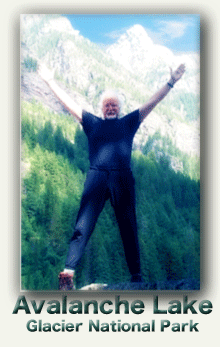
by Gary Powell
The wonderment and monumental beauty of the earth can serve as a map for understanding the expansive nature of the human experience. Few of us “live” there, however. One terrible gift of maturity is no longer seeing my reflection in the popular culture where I actually do “live”. The chasm between these two places has compelled me to engage bigger ideas in order to stretch my capacity for understanding and hopefully not just finding but creating a reflection of my liking.
The theory of special relativity was first to introduce us to the concept of spacetime. Before Einstein, space and time were two different things. He not only imagined, but mapped a system so integrated that the parts could no longer be considered separate. That’s how we might be able to visualize Aristotle’s idea of integrating passion, desire and heart with aspiration, discipline and perfection. The heart and mind become a “whole” new thing and following Einstein’s lead I suggest a new word for it….. HEARTMIND.
“Heart and mind and soul are free and all desire is good by our decree. By nature all creation must agree.”
Lyric from the song “Aristotle’s Prayer”
Maybe it’s time to abandon judgmental designations and their restrictive phrases which label people as right-brained, left-brained, artistic, intellectual or spiritual. Surely, most successful people integrate all that they have and all that they understand and perceive in navigating their life’s course.
“…a pilot, in those days, was the only unfettered and entirely independent,
human being that lived in the earth.” – Mark Twain
In Life on the Mississippi, author Mark Twain used the term unfettered in describing the life of a steamboat pilot. Twain saw the “rank and dignity” of this profession as an ultimate choice of self-determination fueled by aspiration, guided by reason and agreed on by all concerned. Clearly this job description is a young man’s fantasy without regard for the encumbrances of relationships. However, just copy and paste this feeling of living without fear into a more mature understanding of the individual in context of others and we may get a grasp of Aristotle’s mindful and reasonable wish for humanity.
“The pattern of the possible is preferred above the rule.”
Lyric from the song “Aristotle’s Prayer”
A truly mature life lived without fear will not be “stuck” in destructive patterns. To arrive fearlessly, however, the rest of us, whenever possible and each at our own pace, will endeavor to break our patterns which no longer serve us. We now know that patterned entrenchment is not good for human beings. We think we’ve just now figured this out with modern psychology, but Aristotle understood this in 340 B.C.
Truly, “all the wonderment and beauty lay before us and the truth they speak I pray we will believe!”

by Gary Powell<\/p>\n
The wonderment and monumental beauty of the earth can serve as a map for understanding the expansive nature of the human experience. Few of us “live” there, however. One terrible gift of maturity is no longer seeing my reflection in the popular culture where I actually do “live”. The chasm between these two places has compelled me to engage bigger ideas in order to stretch my capacity for understanding and hopefully not just finding but creating a reflection of my liking. The <\/a>song lyric below is the thesis statement for this show, “Aristotle’s Prayer”. It’s hope. It’s a prayer. It’s an alter call and yet has no religiosities. The big idea is this: the world CAN<\/i> be known and our ability to reason remains our best hope for surviving. This is as expressed by Aristotle some 2300 years ago and is an idea still struggling. <\/p>\n The world CAN be known and our ability to reason Both our individual and cultural psychology continues to project or fabricate images of their own making from their raw materials. Our religions each profess to be the one true religion. Our media plays everyone against everything for the promotion of empty profit. Our governments largely fail the individual and all institutions become whatever our psychology allows. Unfortunately for us, this institutional psychology can create and maintain the most heinous of malignant nightmares with relative ease. However, all profit is not empty, all government is not corrupt, and not all institutions enslave and torture. The really good news is that regardless of each of our own projections, our true nature is understandable.<\/p>\n In 1905, Albert Einstein’s theory of special relativity<\/a> was first to introduce us to the concept of spacetime<\/u><\/a>. Before Einstein, space and time were two different things. He not only imagined, but mapped a system so integrated that the parts could no longer be considered separate. That’s how we might be able to visualize Aristotle’s idea of integrating passion, desire and heart with aspiration, discipline and perfection. The heart and mind become a “whole” new thing and following Einstein’s lead I suggest a new word for it….. HEARTMIND<\/u>.<\/p>\n “Heart and mind and soul are free and all desire is good by our decree. By nature all creation must agree.” Maybe it’s time to abandon judgmental designations and their restrictive phrases which label people as right-brained, left-brained, artistic, intellectual or spiritual. Surely, most successful people integrate all that they have and all that they understand and perceive in navigating their life’s course. <\/p>\n “…a pilot, in those days, was the only unfettered and entirely independent, In Life on the Mississippi<\/u><\/a>, author Mark Twain used the term unfettered<\/u> in describing the life of a steamboat pilot. Twain saw the “rank and dignity” of this profession as an ultimate choice of self-determination fueled by aspiration, guided by reason and agreed on by all concerned. Clearly this job description is a young man’s fantasy without regard for the encumbrances of relationships. However, just copy and paste this feeling of living without fear into a more mature understanding of the individual in context of others and we may get a grasp of Aristotle’s mindful and reasonable wish for humanity.<\/p>\n “The pattern of the possible is preferred above the rule.” A truly mature life lived without fear will not be “stuck” in destructive patterns. To arrive fearlessly, however, the rest of us, whenever possible and each at our own pace, will endeavor to break our patterns which no longer serve us. We now know that patterned entrenchment is not good for human beings. We think we’ve just now figured this out with modern psychology, but Aristotle understood this in 340 B.C. <\/p>\n Truly, “all the wonderment and beauty lay before us and the truth they speak I pray we will believe!”<\/p>\n <\/p>\n Words and Music by Gary Powell<\/i> <\/p>\n Verse 1<\/u> So entertain with reason Chorus 1<\/u> And lead where Verse 2<\/u> My reason and my being Chorus 2<\/u> And lead where Bridge<\/u> Regard the good, regard the heart Chorus 3<\/u> This is where (Copyright Jesmax Music, BMI 2005)<\/i><\/center><\/p>\n <\/a> <\/p>\n
remains our best hope for surviving.<\/p><\/blockquote>\n
Lyric from the song “Aristotle’s Prayer”<\/i><\/p><\/blockquote>\n
human being that lived in the earth.” – Mark Twain<\/p><\/blockquote>\n
Lyric from the song “Aristotle’s Prayer”<\/i><\/p><\/blockquote>\n
Creative Commons Attribution-NonCommercial-NoDerivs 2.5 License
\n
\n<\/a>.<\/center><\/p>\nARISTOTLE’S PRAYER<\/h2>\n
\nMost know I am of one mind
\nOf passion and desire
\nAnd now I know perfection wants
\nA heart that will aspire<\/p>\n
\nThe enlightened and the sad
\nFor wisdom holds in both it\u00e2\u20ac\u2122s arms
\nThe methodic and the mad<\/p>\n
\nAll the wonderment
\nAnd beauty lay before me
\nAnd the truth they speak
\nI pray we will believe
\nAnd we\u00e2\u20ac\u2122ll awaken to the hope
\nFear will have us with whom to cope<\/p>\n
\nHeart and mind and soul are free
\nAnd all desire is good by our decree
\nBy nature all creation must agree<\/p>\n
\nI say \u00e2\u20ac\u0153well begun is half done\u00e2\u20ac\u009d
\nEntrenchment makes the fool
\nThe pattern of the possible
\nIs preferred above the rule<\/p>\n
\nKnow the necessary truth
\nIt does not bow before my faith
\nAnd will not bow to youth<\/p>\n
\nAll the wonderment
\nAnd beauty lay before me
\nAnd the truth it speaks
\nI pray we will believe
\nAnd we\u00e2\u20ac\u2122ll awaken to the hope
\nFear will have us with whom to cope<\/p>\n
\nHeart and mind and soul are free
\nAnd all desire is good by our decree
\nBy nature all creation must agree<\/p>\n
\nFaith has locked it\u00e2\u20ac\u2122s own door
\nBut reason and the mind
\nLong to clear the way
\nto find the passage safe
\nWhere reverence yields
\nLet thought be shields<\/p>\n
\nRegard desire, if good it will impart<\/p>\n
\nAll the wonderment
\nAnd beauty there before us
\nAnd the truth it speaks
\nI pray we will believe
\nAnd we\u00e2\u20ac\u2122ll awaken to the hope
\nFear will have us with whom to cope<\/p>\n
\nHeart and mind and soul are free
\nAnd all desire is good by our decree
\nBy nature all creation now is free
\nFree
\nFree
\nFree
\nFree<\/p>\n\n
\nAristotle in Jewish Legend<\/a>
\nCatholic Encyclopedia on Aristotle<\/a>
\nNon-conradiction.com – Aristotle and Aristotelianism<\/a><\/center><\/p>\n","protected":false},"excerpt":{"rendered":null,"protected":false},"author":1,"featured_media":0,"comment_status":"open","ping_status":"open","sticky":false,"template":"","format":"standard","meta":[],"categories":[10],"tags":[],"jetpack_featured_media_url":"","_links":{"self":[{"href":"http:\/\/www.garypowell.com\/blogs\/wp-json\/wp\/v2\/posts\/90"}],"collection":[{"href":"http:\/\/www.garypowell.com\/blogs\/wp-json\/wp\/v2\/posts"}],"about":[{"href":"http:\/\/www.garypowell.com\/blogs\/wp-json\/wp\/v2\/types\/post"}],"author":[{"embeddable":true,"href":"http:\/\/www.garypowell.com\/blogs\/wp-json\/wp\/v2\/users\/1"}],"replies":[{"embeddable":true,"href":"http:\/\/www.garypowell.com\/blogs\/wp-json\/wp\/v2\/comments?post=90"}],"version-history":[{"count":3,"href":"http:\/\/www.garypowell.com\/blogs\/wp-json\/wp\/v2\/posts\/90\/revisions"}],"predecessor-version":[{"id":1563,"href":"http:\/\/www.garypowell.com\/blogs\/wp-json\/wp\/v2\/posts\/90\/revisions\/1563"}],"wp:attachment":[{"href":"http:\/\/www.garypowell.com\/blogs\/wp-json\/wp\/v2\/media?parent=90"}],"wp:term":[{"taxonomy":"category","embeddable":true,"href":"http:\/\/www.garypowell.com\/blogs\/wp-json\/wp\/v2\/categories?post=90"},{"taxonomy":"post_tag","embeddable":true,"href":"http:\/\/www.garypowell.com\/blogs\/wp-json\/wp\/v2\/tags?post=90"}],"curies":[{"name":"wp","href":"https:\/\/api.w.org\/{rel}","templated":true}]}}