Galileo Betrayed by Inquisition


“How Do I Go On from Here?” from Aristotle’s Prayer

by Gary Powell

There are different genres of betrayal, to use a musical term. By definition, betrayals are compromises of our trust either by greed or passion. However, there are worse betrayals.
The source of these betrayals is always detectable in psychology, but how do we divine the source and prevent it from happening again? More important, how do we recognize any responsibility we may have in it?

There are those secret-life betrayals which cause offense outside of all acknowledged agreements or honored traditions. A Herculean effort must be mounted just to go forward after this kind of disconsolate discovery. These are the private betrayals, but the public betrayals can be more injurious yet.

There is also the betrayal served to us at the secret discretion of the institution, the corporation or… wherever large groups of individuals with, what Austin therapist Amy Person calls “lost voices”, gather. All manner of atrocities have been perpetrated on humanity in the name of “US”, at the price of “ME”. This is the slow-burn betrayal which can unknowingly obstruct our productive and passionate contributions to this world for an entire lifetime.

All these different shades of betrayal are common and experienced by nearly everyone.

On the other hand, we are seldom aware when our APTITUDE or our POSSIBILITIES have been hijacked!

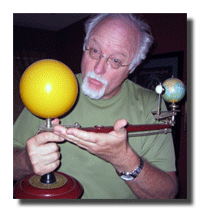
Slavery, certainly, is the blackest of all betrayals as it extinguishes our corporal, natural, inherited, learned and earned humanity. Common slavery is easily identified. However, how do we know when our very “personal intellect” itself has been misappropriated or conscripted into service? This idea of “personal intellect” lives at the core of Galileo’s wonderful gift, which unfortunately existed during an unenlightened time in a place where the keepers of “lost voices” held court.

Galileo Galilei knows betrayal. Under the jurisdiction of the Catholic Church Inquisition Court, Galileo, one of the greatest minds ever produced by humanity, was sentenced to life in prison for THINKING. Actually, he was way past just thinking. His thoughts were not idle musings. They were scientifically PROVEN, yet a small-minded institution stripped him of his intellectual voice and every other expression of freedom.

In the show, Aristotle’s Prayer, Galileo’s grief is presented in the song, “How Do I Go On from Here?”, and was written from this intellectual giant’s very public perspective of his own betrayal. It immediately follows the song of his trial, “The Boys in Red”. It’s not a dead, historical betrayal with no meaning or feeling. It is a betrayal which we each may share with Galileo, but have yet to feel the knife.

All Content of Gary Powell’s Site is Licensed Under a
Creative Commons Attribution-NonCommercial-NoDerivs 2.5 License

.

Continue reading

Galileo Betrayed by Inquisition

“How Do I Go On from Here?” from Aristotle’s Prayer

“A Texas Symphony”


1989 Film-Score Remastered

by Gary Powell, Composer

EXECUTIVE PRODUCER: John Harms
OFF-LINE EDITOR: Glenn Wolfe
ON-LINE EDITOR: Bill Lewis
COMPOSER: Gary Powell
ORCHESTRATOR: Gary Powell
RECORDING & MIXING ENGINEER: Larry Seyer

(Musical Score Copyright 1989 Jesmax Music, BMI
Copyright IBM Corporation 1989 All Rights Reserved)

______________________________________________

The call came in from John Harms of River City Productions in Austin, Texas for an original film-score for an IBM project. I had composed and produced dozens of these in the past usually around some new computer chip rollout. This time, John says, “This one is different. No talking heads. Only beautiful shots of Texas landscapes and people.” The date is October, 1989!

This piece of work, without my planning it, was to soon set me up with Ted Kryczko of Walt Disney Records as more than just another song producer. This creative happenstance unknowingly presented a life-changing opportunity for this much younger Austin film composer. All I knew at that time was that these filmed scenes of Texas were beautiful, exciting to score and had a very real budget.

IBM installed a major video and slide projection system in a conference room solely designed to showcase “TEXAS” to foreign dignitaries. Wanting to eliminate any possible language barriers, they wisely let the music and cinematography do the talking.

The process was for me to compose the music first, then Glenn Wolfe would cut the video to my score. Glenn showed me all the footage he had amassed and how he planned to collate, staple and creatively glue this thing together. I decided to write the music within his organizational framework of different visual sections of landscapes, coastal and inland water, building-scapes, people, etc. It was obvious this film-score needed to be composed as an orchestral piece which would also give it a long shelf life. I delivered a midi-only score to Glenn for him to pre-cut his collected images. With a few timing changes, I then hired my regular orchestra players, mostly from the Austin Symphony Orchestra, and recorded and conducted the score from a click track to maintain sync with the now edited version.

As you watch, remember this was 1989 which preceded any non-linear video editors! I re-mastered the audio for this posting, which is now much improved from the 1989 technology. The dreaded tape hiss of the last millenium is now removed.

I would like to give special mention to the banjo and guitar parts performed by Danny Barnes. Although mostly improvised, Danny was musician enough to integrate some of my individual orchestral lines into his playing, which made his banjo and guitar parts sit within the score rather than just on top of it. Danny is a truly great player and musician.

Thank you, John Harms and Gary Schmidt, owner of River City Productions, for this pivotal musical scoring and career building opportunity!

THE RHYTHM SECTION
BANJO & GUITAR: Danny Barnes
ACOUSTIC BASS: Spencer Starnes
DRUMS: John Trainer

Austin Jazz Pianist Rich Harney

by Gary Powell, Austin Vocal Producer

richRich Harney is a small man by physical stature, but you’ll think again when when hearing him play piano.
RICH HARNEY PLAYS DEEP!

I have known Rich for a couple of decades just from both of us being in the Austin music scene. He knows I specialize in working with studio singers and studio choral recordings are a mainstay of my production business. I am honored that Rich sought me out for the recording of “Jesus, Lamb of God”, which is Rich’s new choral composition. The piece is haunting and healing largely from the beautiful colors drawn from Rich’s harmonic personal library.

You can hear pianists thinking as they play. Some are linear players always headed to the next line or melodic improvisation. I’m almost sure I can hear Rich Harney thinking vertically. He has a wonderful command of the jazz harmonic idiom and improvises in every vertical moment with great acumen and sense of sonority adventure. Wow, that was a mouthful and probably only made sense to music composition majors!

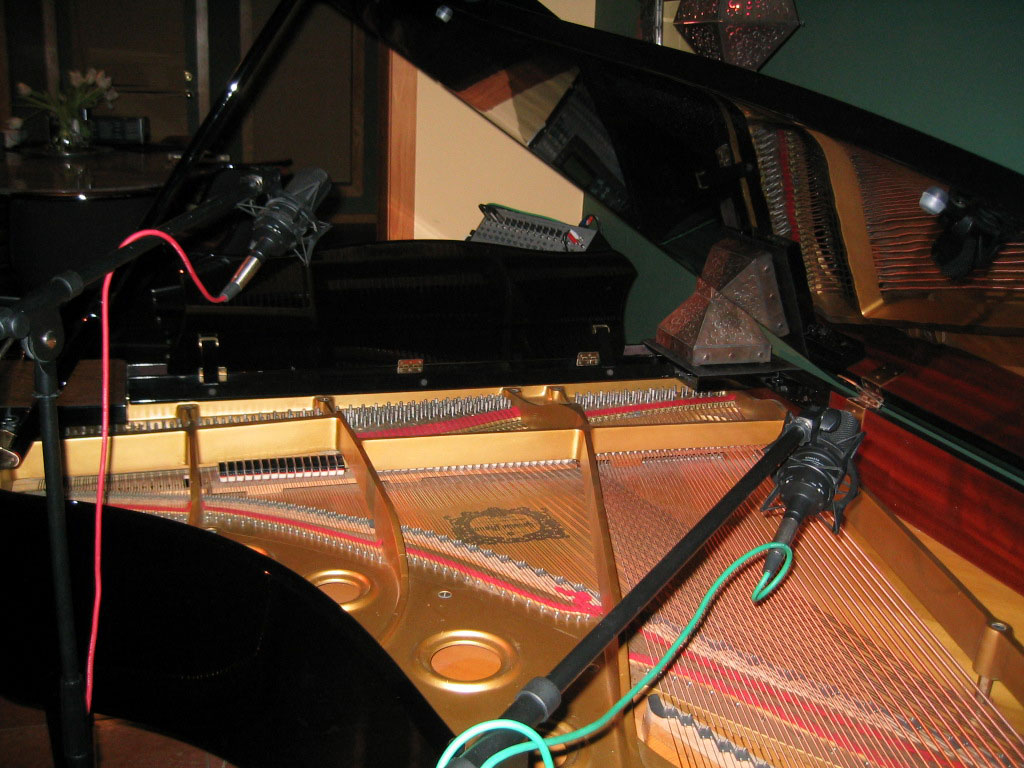
Rich composed his choral piece, “Jesus, Lamb of God”, with a piano accompaniment which we decided to record first. I have two Yamaha pianos. In the studio is a Yamaha C7 (7’4″) and in the screening room is a much more mellow Yamaha G5 (6’5′). The G5 was manufactured in Japan with a slightly different cabinet and design seemingly voiced for the classical pianist’s ear. Rich preferred the G5 for its softer tone.

Both Yamaha pianos are meticulously maintained by Brian Henselman, owner of Music Masters Piano Service here in Austin, Texas. I purchased the G5 from Brian who is a great source for people who are serious about locating the perfect instrument.

gary
Click Piano Photo to Enlarge

When I want to record the G5, which is not in the studio proper, I record on my Apple G4 powerbook using MOTU’s Traveler interface with a pair of AT-4033’s at 24bit 44.1k . Rich gave an incredible performance which included a solo before recapping the main theme. A couple of takes for microphone placement and a couple of takes for creative decisions and we were done. Studios can certainly mask the marginal skills of musicians. This is mostly not true for the jazz community who do not hide behind technology and navel rings. Rich Harney, from among the best, is a very consistent and deliberate player and this piece proves it.

To prepare for the choir, I took Rich’s piano performance into the studio and built a click track from his rubato performance. I do this just in case we need a click for the singers, but also for good “housekeeping” which makes locating much faster during subseqeunt sessions. This kind of preparation makes for a much smoother and enjoyable session for our Austin studio vocalists.

I am proud to have been a part of this project. I’ll write about the choral recording session soon and introduce those singers.

Rich Harney gigs and records with Austin’s best. In 2003, Rich and saxophonist/flutist Alex Coke released “Soul Prayers”. Rich Harney has also recorded with jazz vocalist Beth Ullmann which you can find at “Heart Music”.